


























Natasha’s experience of DVT during pregnancy tested her physically and emotionally—but led to a deeply positive and supported birth.
The Pregnancy
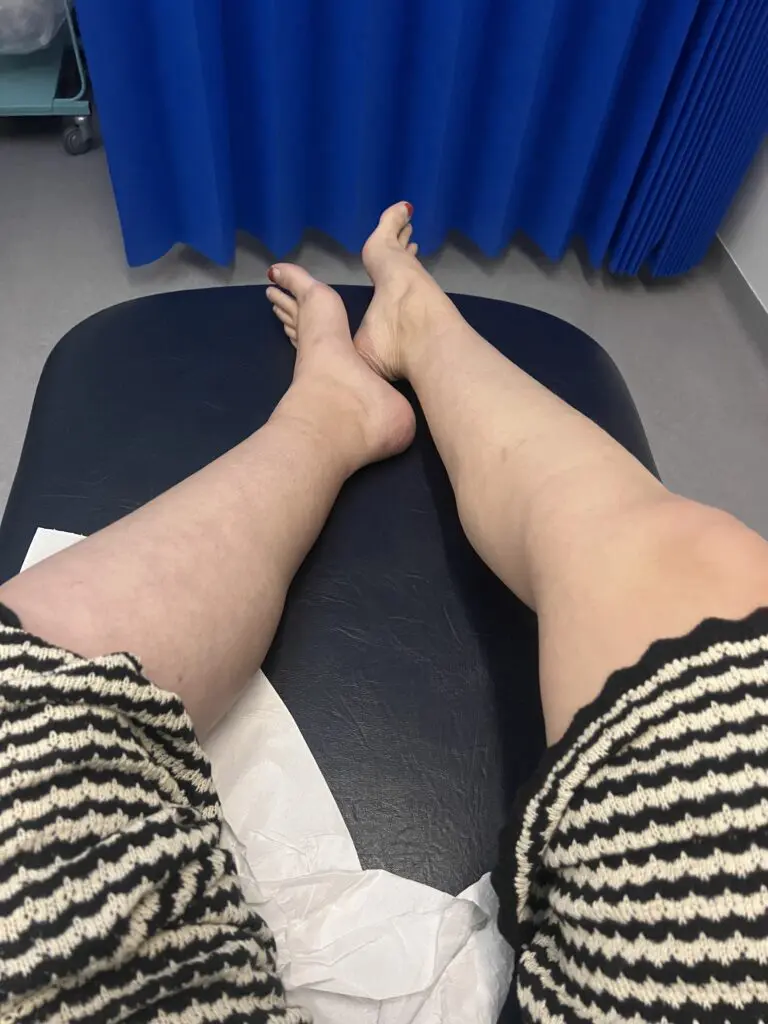
At 25 weeks pregnant, I experienced a sudden, severe pain down my left leg and buttock, initially diagnosed as pregnancy-related sciatica. Over the following days, despite trying to relieve it with yoga and reformer Pilates, the pain worsened and moved into my left groin. I soon became unable to put weight on my leg. While waiting at an urgent GP appointment, my leg swelled dramatically and turned purple and mottled, and I was sent straight to A&E with a suspected blood clot.
An ultrasound confirmed an extensive clot running from my knee up to my pelvis and lower abdomen. Because I was pregnant, the full extent of the clot could not be confirmed with a CT scan. I spent two nights on the AMRA ward at hospital, undergoing further tests while midwives monitored my baby, who thankfully was absolutely fine throughout. Desperate to leave hospital, I was eventually discharged with a crutch despite still struggling to walk and needing significant support from my husband, Matt, at home. Thankfully both sets of grandparents stepped in to help with my toddler whilst I was in hospital and during the initial period at home. It was such a boost though when we were eventually reunited with him, and he wanted desperately to help me as much as he could by holding my other hand whilst I hobbled with the crutch and Matt’s support.
Unfortunately, after a few days at home the pain worsened, and I headed back into hospital. This time a specialist team, including a Consultant Obstetrician, Consultant Haematologist, senior midwife and a DVT specialist nurse, assessed me. Due to my limited mobility, worsening pain and emotional distress, I was re-admitted to the antenatal ward, where I felt far more supported and it was a much more positive experience. With stronger pain relief and blood thinners, my symptoms improved over the next two days, and I was able to move short distances independently with a crutch and no additional support. Following this, my mobility improved significantly at home.
The same specialist obstetrician and haematology team supported me throughout the remainder of my pregnancy at monthly appointments. Using the B.R.A.I.N acronym, they worked closely with me to develop a birth plan that balanced my DVT treatment with my preference for another vaginal birth. To safely manage the timing of blood thinners and preserve pain relief options, they recommended induction shortly before my due date at 39 + 5 days, because if I went into spontaneous labour within 24 hours of taking blood thinners, medical pain relief options would be severely limited, potentially requiring a C-section under general anaesthetic, which was something I was desperate to avoid. Given that I had a really positive induction during my first pregnancy (my body responded very quickly to the pro-pess pessary), I was happy with this plan.
The induction process
We arrived at the induction suite at 10:00, where we were welcomed by Becky the midwife and settled into a private room. Unlike my first induction where I was an outpatient so could go home between the induction and established labour, this time I had to have it as an inpatient due to the DVT risk. However, we were still able to set up the room exactly as we wanted – we dimmed the lights, set up battery-powered candles, and used lavender oil on pulse points, to create a calm, oxytocin-boosting environment. It was really cosy and felt like our own little sanctuary.
The pro-pess pessary was inserted at around 13:30, and within half an hour I began experiencing regular surges every five minutes, though they were initially mild and lasted around 20–30 seconds. Over the afternoon they steadily increased in intensity, duration and frequency. By 16:00 they were occurring roughly every two minutes and lasting 40–50 seconds but based on my previous birth experience we recognised that, despite meeting the threshold for the labour suite, they were not yet intense enough to indicate established labour as I was able to talk through them and didn’t really need to use my up-breathing yet. By 17:00 they’d ramped up, but using my TENS machine and up-breathing, I felt in control.
After a shift handover, the new midwife, Lorna, examined me as the pessary had become uncomfortable. She confirmed it had dropped slightly and removed it. Although my cervix had not yet dilated, it was paper-thin, which indicated good progress.
Between 19.00 and 22:30, the surges intensified. I removed the TENS machine as it began to feel irritating and put on my birth playlist. I was frequently going to the toilet and was sick twice – signs I recognised as my body preparing for birth. Lorna tried to move us to the labour suite, but no midwife was available due to a particularly busy period. I continued labouring in the induction suite, leaning on Matt during surges and using breathing techniques, something I had also done during my first birth and recognised as a sign things were progressing. By this point I had no pain relief, as gas & air was not available in the induction suite and the paracetamol I was given came straight back up. Lorna later told us she had described me to the labour suite as “very noisy,” as I had begun groaning and mooing through surges, and was pushing to have me transferred quickly as she believed I was close to giving birth.
The birth
Just before 23:00, Lorna introduced us to the midwife who would take us across to the labour suite. We recognised her straight away as Hannah, the midwife who delivered my first baby! Matt and I looked at each other in disbelief and told her at the same time “you’re the midwife who delivered our first baby!”. As we’d had such a positive first birth with Hannah, this felt like a really special and significant sign. As we entered the room in the labour suite, the lights were quickly dimmed. Whilst Hannah set up the gas & air, my surges became very intense with only a few seconds as a break.
I started having back-to-back surges, which were intense but I was still using my up-breathing techniques with Matt’s help to manage the pain; however, at this point he knew the baby was coming imminently. He helped me over to the bed, and I suddenly felt a pop as my waters finally broke all over the floor (and his shoes). I was quickly put on the bed and finally given gas & air!
I immediately felt the urge to push and shouted that the baby was coming. Hannah said she could see the top of the head and told me to control my pushing, so I could avoid a 3rd degree tear (which I had in my first birth). She talked through the birth as it happened so quickly, with only one minute of pushing: “I can see the head, the shoulders are following, the body is following nicely, and the baby is out”. Evelyn was born at 23:15.
I was incredibly grateful to have another positive birth experience. The midwives listened to me throughout and trusted me to guide the process, recognising that as a second-time mum I was familiar with how my body moved through the stages of labour. They encouraged me to follow my instincts and respond to what my body needed in each moment. Even with a structured haematology birth plan in place, I still felt a strong sense of ownership over my labour. I was able to create a calm environment and use the hypnobirthing techniques that had helped me before, including up-breathing, dimmed lighting, and my birth playlist, which all helped me stay grounded and focused as things progressed.